Through the Ages

Through the Ages
Showing posts with label British Army. Show all posts

Monday, 29 November 2021

The Chibnall Years: 2018 - 2022

Doctor Who: Flux


"Survivors of the Flux"


After a 5-year absence, UNIT finally returned in the series 13 episode “Survivors of the Flux”, which was Part 5 of the Doctor Who Flux story arc. Notably, not only did we see modern, current-day UNIT, we also saw the earliest chronological appearance of UNIT, pre-dating their first appearance in “The Invasion”.

I am not going to go into the timeline, and the dating of the UNIT stories here, because there are other websites that will go into far more detail about it than I. Needless to say, this episode merely added to the already confused chronology of UNIT and certainly raised a whole host of questions.


We learn in this episode that the very first Commanding Officer of the British branch of UNIT (and indeed the man who set it all up – presumably as part of a concerted United Nations operation) was General Farquhar. The general wears a standard British Army general’s Service Dress uniform.


On his upper left arm he wears a UNIT patch, which matches the patches worn by the likes of Brigadier Lethbridge-Stewart, Captain Yates, and Sergeant Benton on their Service Dress uniforms.


Farquhar was also correctly wearing the red lanyard that we saw UNIT officers wearing during this period – except he was wearing on the wrong arm. The Brigadier and other officers always wore their lanyards on the right. It should be noted that we did sometimes see Sergeant Benton wearing his lanyard on the left, however.


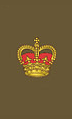
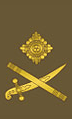
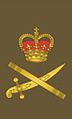
One final observation about the general (technically an error, but an eminently forgivable one); you can see on a number of occasions that the rank insignia on the general’s epaulettes are attached using clip pins. 


This is the modern way to attach rank insignia.
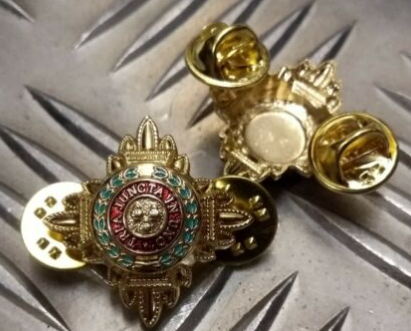


In the 1960s it would have been attached using split pins.


This is very nit-picky and I wouldn’t expect the costume department to go to the lengths of finding old-style insignia. I merely mention it as interesting.


The UNIT soldiers in this episode are wearing British Battledress uniform.


This is an anachronism for two reasons. Firstly, UNIT troops in these early years wore the beige uniforms seen in “The Invasion” and “Spearhead from Space” etc. (UNIT Uniforms: The Early Years: 1968 - 1970) – of course, it’s entirely possible that UNIT troops were initially kitted out with uniforms from their home-country’s armed forces, before switching to the beige uniform a year or two later. But that brings us to the second problem; the British Army stopped wearing Battledress uniforms in 1961, so they are seven years out of date. But look closer and it’s even more anachronistic that it seems.


There were three styles of Battledress worn by the British Army – 1937 pattern, 1940 pattern, and 1949 pattern.


1937 pattern

1940 pattern

1949 pattern


 The style worn by the UNIT soldiers in this episode is the 1937 pattern, so it is the oldest and most out-of-date of all the Battledress uniforms. This style was not seen worn much after the Second World War, 20 years before the events of this episode.


Having said all that, there is precedent for UNIT troops wearing out-of-date uniforms. During the Golden Years of Pertwee’s Third Doctor, UNIT were kitted out in 1960s combat fatigues, despite being in the 1970s (or was in the 80s?). Ironically, the combat fatigues they wore in those days are what they should more correctly be wearing in this episode, since it is set in 1967.


The soldiers in this episode wear their Battledress open at the collar, with a shirt and tie beneath.


 Like Farquhar, they have a UNIT patch on their left sleeve.


The soldiers wear the correct sand-coloured beret for this era, but for some reason, they all wear it backwards! The badge should be above the left eye with the beret folded over the right ear, but Jennings and the two soldiers in the corridor wear them the opposite way around.


 You can just about see that the beret has the old-style UNIT badge on (although slightly smaller than the original). Private Jennings also wears this UNIT badge on the collars of his Battledress uniform, which is a nod to the collar badges worn by Yates and Benton on their Service Dress uniforms.


 So, in summary, the UNIT soldiers in this scene certainly evoke the feel of the 1960s UNIT troops, but on closer inspection are in fact, entirely anachronistic.


We also get a very brief glimpse of modern UNIT in this episode. In addition to Kate Stewart, we see a female UNIT soldier ordered to aim missiles at Earth. She is wearing a black shirt which was last seen being worn by UNIT personnel at the UNIT command post in Turmezistan in “The Zygon Invasion”.


 Like the UNIT troops in Turmezistan, this soldier wears the new UNIT logo on a badge on her chest. At first it appears that this badge is now on the left breast rather than the right – but if you look closer you can see that UNIT is written backwards on it, and also on the screens behind her. This means that this image has been flipped in post-production, so the badge was still actually worn on the right. Here's how it should have looked...


She also wears the old RTD style UNIT wings as a patch on her upper sleeves, and as a badge on her red beret, which is folded under her epaulette.


 A final note:


In the scene at UNIT HQ, General Farquhar hears the voice of Lethbridge-Stewart (taken from an audio-clip of Nicholas Courtney in the episode “Terror of the Autons”). Farquhar then says, “That’s our new Corporal”.

This line entirely ruins the whole UNIT scene for me. Corporals are NCOs, whereas Lethbridge-Stewart was an officer. These are two entirely different career routes in the army, and someone who was a corporal (which is a very junior rank), would never rise to the rank of Brigadier – as you can see from the table below.


 It is certainly possible for someone to be ‘promoted from the ranks’ – for example, experienced Warrant Officers will be given officer training and granted a commission, thusly then being promoted to a junior officer rank like captain - but in these cases you have older soldiers in junior officer roles, and Lethbdridge-Stewart is not old enough for this to be the case.


 If he were a corporal in 1967, there is no way he could then be a lieutenant colonel in 1968 in “The Web of Fear”. And he certainly wouldn’t rise to the rank of brigadier.

(And on another note, based on this episode, are we now also assuming that he was with UNIT all along in “The Web of Fear”?)


Frankly, the “Corporal” line was an example of lazy writing and no research on how the military works. What would have been better is if Farquhar had said, “That’s our new Colonel.” That would have made far more sense.


The Lethbridge-Stewart cameo had the potential to be a highlight of the episode and have me squealing in delight. Instead, the glaring mistake just had me sighing and rolling my eyes.


It is not just Doctor Who that is guilty of this (although it has been a major offender in recent years), but I do wish that if modern writers are going to write about the military, they would actually do some research to find out how it actually works. The Ministry of Defence has a very useful page on their website about it:


Rank Progression - British Army Jobs (mod.uk)


Wednesday, 2 December 2015

Medals

One oddity to note from the early UNIT era is that the Brigadier is the only member of UNIT we ever see with any medals ribbons on his uniform. Logic, however, tells us that Sergeant Benton should also have medals. It typically takes about twelve years (minimum) to attain the rank of sergeant, suggesting that Benton should have seen some form of action in the 1960s (the British campaigned in Korea, Borneo, Radfan, South Arabia, Malay Peninsula, South Vietnam, Northern Ireland, and Dhofar, in the 1960s, all of which were eligible for a General Service Medal). Not to mention that fact that he would conceivably have won other decorations for bravery or gallantry (such as the Military Medal, for example) or exemplary conduct. The many Captains that served under the Brigadier (Munro, Hawkins, Turner, Yates) could also have been awarded medals. Since UNIT would surely only recruit the best of the best from the services I find it hard to believe that none of them have ever been decorated. Obviously, the real reason was that the costume department probably had neither the time nor the inclination to source the correct medals for each character’s history, beyond the Brigadier himself.

Brigadier Alistair Lethbridge-Stewart CMG DSO


With regards to the Brigadiers medals, on the top row he has the Order of St Michael and St George (presumably he's a Companion of the Order, since any higher and he would have been a Sir, which we know doesn't happen until much later); the British Empire Medal (awarded for meritorious military service worthy of recognition by the Crown); and the Distinguished Service Order (DSO), which in actual fact means he should properly be addressed as Brigadier Alistair Lethbridge-Stewart CMG DSO (It should also be noted that the order of precedence is wrong; the DSO should come before the British Empire Medal). On the bottom row of medals he wears the General Service Medal; and the Queen Elizabeth II Coronation Medal. After this he wears medal ribbons for foreign awards he has earned, including the Legion of Merit; the medal of a Chevalier of the Legion of Honour; and the Canadian Forces Decoration.

The Brigadier's medal ribbons during the early 1970s


Regarding medals, it should also be noted, just to add to the UNIT dating controversy, that none of the military characters wear the Queen Elizabeth II Silver Jubilee Medal, which was issued in 1977 to commemorate the twenty-fifth anniversary of Elizabeth II’s accession to the throne of the United Kingdom. This suggests, as observed in the Fifth Doctor Story “Mawdryn Undead” that the UNIT stories do indeed take place before 1977 (interestingly, in “Battlefield” it can be seen that this particular medal has actually been added to the Brigadier’s Service Dress uniform).

Thursday, 12 November 2015

Glossary of Terms

For the purposes of this blog I have split the UNIT uniforms into six distinct eras, which will be as follows:

The Early Years: 1968 to 1970
The Golden Years: 1971 to 1975
The Sporadic Years: 1975 to 1983
The Wilderness Years: 1989 to 2005
The RTD Years: 2005 to 2010
The Moffat Years: 2010 to date

Throughout this sartorial chronology I shall use a number of terms relating to the military, so to avoid any confusion I shall outline those terms before I begin:

Officer – this refers to any member of the military who holds a commission from Her Majesty the Queen. They are therefore sometimes referred to as Commissioned Officers. Officers in the British Army have all attended The Royal Military Academy Sandhurst.

Officers in UNIT are generally seconded from the Army (though we have also seen officers from the Royal Navy and the Royal Air Force). Officer ranks in the British Army are as follows (in ascending order):


Second Lieutenant
OF-1

Lieutenant
OF-1

Captain
OF-2

Major
OF-3

Lieutenant Colonel
OF-4

Colonel
OF-5

Brigadier
OF-6

Major General
OF-7

Lieutenant General
OF-8

General
OF-9


During UNIT's appearance in the classic series, there was also an even more senior officer rank of Field Marshal (OF-10), but this is now defunct in the UK as it is classed as a wartime rank.

Officers wear their rank insignia on shoulder epaulettes.

Other Ranks (ORs) – this refers to anyone who is not a commissioned officer and includes Warrant Officers, Non-Commissioned Officers (Corporals and Sergeants), and Private soldiers.

The OR ranks, in ascending order are:

Private
OR-1 and OR-2

Lance Corporal
OR-3

Corporal
OR-4

Sergeant
OR-6

Staff Sergeant
OR-7

Warrant Officer Class 2
(Company Sergeant Major)
OR-8

Warrant Officer Class 1
(Regimental Sergeant Major)
OR-9
 
 
NCOs (Lance Corporal up to Staff Sergeant) wear their rank chevrons on their upper arms; Warrant Officers wear their rank insignia on their cuff (however, it should be noted that in the modern-age where UNIT ORs wear all-black SWAT uniforms, ranks are displayed differently). 

Note: the letter and number underneath each rank is the corresponding NATO code, which is assigned to every rank in the armed forces and allows different country's armies, navies and air forces to see how each of their ranks corresponds with each other, and with other country's equivalent armed forces. This is probably especially useful for UNIT who have personnel from different branches of each armed service in every UN country in the world.

Uniforms

For much of their run, UNIT wore standard British Army uniform. However, the British Army have a variety of different uniforms for various occasions ranging from ceremonial to combat. This is how they classify them:
 
Full Dress – This is the most elaborate uniform available, and is only worn these days by the Foot Guards and Guards Regiments. It is the scarlet jacket you will see being worn by soldiers guarding Buckingham Palace, for example.
 
Full Dress Uniforms of the Guards Regiments
From Left to Right: Grenadier Guards, Scots Guards, Welsh Guards, Irish Guards, and Coldstream Guards
 
 
No. 1: Temperate Ceremonial Uniform (also referred to as Dress Uniform, or Dress Blues) – This is a universal ceremonial uniform worn on specific ceremonial occasions. For most regiments it consists of a midnight blue tunic and trousers, worn with a peaked cap.
 
Various different patterns of No 1 Dress being worn at the Royal Military Academy Sandhurst
Front row (from left to right) A Major General, a General, a Royal Artillery officer, and a Royal Navy officer
Stood to attention behind them are Officer Cadets; the mounted soldier belongs to a Scottish regiment
 
 
No. 2: Service Dress – This is the standard khaki jacket and trousers that many people associate with the army. It is used as a temperate parade uniform. Current regulations specify that all ranks wear the same style of Service Dress, but previous regulations had separate patterns for officers and ORs.
This is a uniform that we will see being worn by UNIT a lot.
 
Two styles of Service Dress
The old OR pattern uniform (left) and the new all-ranks pattern (right) known as Future Army Dress


No 3: Warm Weather Ceremonial Uniform – This is the equivalent of the No 1 Dress Uniform, but worn on overseas assignments in climates that are considered “hot-weather”. It consists of a white tunic over No 1 Dress trousers. Most recently, this style of uniform was seen being worn by Prince Harry whilst in Australia.
 
Captain Wales (Prince Harry) in the No 3 Dress of the Blues and Royals
 
 
No 4: Warm Weather Service Dress (officers only) – Similar to No. 2 Dress, but stone-coloured and made of a lighter fabric.
 
General Sir David Richards (former Chief of the Defence Staff) wearing No 4 Dress
 
 
No 5: Battledress (now obsolete) – Worn between 1939 and 1961 this is the woollen combat uniform worn throughout Word War II and will be most familiar to people who enjoy Dad’s Army as it is the uniform they wear (from Series 4 onwards).
 
The cast of the BBC TV series Dad's Army dressed in No 5 Battldress uniforms
 
 
No 5: Desert Combat Dress (now obsolete) – This was jacket and trousers in sand-coloured DPM, worn in desert environments such as the First Gulf War and the early years of Iraq and Afghanistan. Since 2011 it has been replaced with a new style of Combat Uniform.
 
Lieutenant Wales (Prince Harry) and other officers wearing No 5 Dress


No 6: Warm Weather Parade Uniform (also known as a Bush Jacket) – In Australia it is known as the “safari uniform”. It is issued to all officers and ORs on posting to a warm weather station and consists of a tan-coloured jacket and trousers that can be worn with or without shirt and tie underneath.
 
No 7: Warm Weather Barrack Dress – A tropical stone-coloured shirt and trousers uniform.
 
No 8: Temperate Combat Dress – The current No 8 Dress was introduced in 2011 and is known as Personal Clothing System – Combat Uniform (PCS-CU) and is based around a multi-terrain pattern that is interchangeable with both woodland and dessert environments.
 
General Sir David Richards wearing the new No 8 Dress, known as PCS-CU
 
 
Previous to 2011, No 8 Dress consisted of Combat Soldier 95, which was similar to the new uniform, but patterned in the old-style of DPM camouflage, which was only suitable for woodland warfare.
 
Lieutenant Wales (Prince Harry) dressed in Combat Soldier 95
 
 
Before CS95, soldiers wore an older style of combat gear (which can be seen on UNIT troops in the Seventh Doctor’s era, as well as being worn in the TV series Soldier Soldier).
 
1990s-era No 8 Dress, as seen in the TV series Soldier Soldier
 
 
Before that an even older style of combat fatigues were worn, which date back to the 1960s.
 
No 9: Tropical Combat Dress (now obsolete) – This was a shirt and trouser combo patterned in DPM, but made from a lightweight material suitable for wear in tropical environment.
 
No 10: Temperate Mess Dress – The military equivalent of a Dinner Jacket; Mess Dress uniforms come in a variety of different cuts and colours, depending on regimental traditions, and are usually worn with a black bow tie and dress shirt. This uniform is worn for formal evening functions.

Each regiments has an individual style of No 10 Dress. Here are a small example of the variety of Mess Dress patterns available:
 
The Life Guards

Coldstream Guards

Royal Artillery

Royal Electrical and Mechanical Engineers (REME)

Intelligence Corps

Parachute Regiment


No 11: Warm Weather Mess Dress – In tropical environments, a white jacket is worn instead on the coloured one of No 10 Dress.
 
No 12: Protective Clothing – This order of dress includes clothing such as overalls, worn by engineers and technicians, to specialist kit worn by aircrews, chefs and medics etc.
I suspect the black SWAT gear worn by modern UNIT troops would fall into this category.

Protective coveralls fall under No 12 Dress
 
 
No 13: Temperate Barrack Dress – This is the thick woollen jumper worn over shirt and trousers that was often worn by the Brigadier in Doctor Who. In real life, the pullover worn by some Regiments and Corps are cut differently or come in a variety of colours, depending on tradition.
 
Officer of the Life Guards in No 13 Dress


No 14: Shirt Sleeve Order – The same as No 13 Dress but with the jumper removed and the sleeves of the shirt rolled up. This dress is allowed during the summer months.
 
Officer of the Life Guards in No 14 Dress

NCO of the Life Guards in No 14 Dress


So, I think that covers the basics. Without further ado, let's delve into the world of UNIT's sartorial development.